As you know, practice makes perfect! Every week, along with each lesson, you are given some words or sentences to practice. I know that, as a beginner, you will find it difficult to read the entire words by yourself. Therefore, you are not asked to either read or write these words at this stage. Please do not try to pronounce these words on your own or you will remain in an insolvable confusion for good. All you have to do is identify the letters and words you have already studied. So, first go to the This week and study the new lesson carefully. Then click on the Useful drills button to get connected to this page. On this page you will find some words that seem quite stranger to you at the first glance. Nevertheless, you must at least be able to recognize the letters and words you have just studied on This week. And this is all I want you to do.
NOTE: as you see in the following words, there are no symbols (signs) on or under the letters. We, as beginners, use these symbols during our lessons to learn the correct pronunciation of the words. Later, after you got enough familiarity with the words and the way they are pronounced you would find it redundant to use these symbols with letters, except for some ambiguous words that are not used very often. I have eliminated these symbols on purpose to let you see the real Persian words that take no symbols with them.
Look at this word:  /didæn/.
It means ‘to see’. Now simply delete  from the end, and you’ll have
  /did/
/did/
Now pronounce this word with the subjective pronouns. Example:
I saw=  /mæn didæm/.
+  /æm/
/æm/
You saw=  /to didi/.
+  /i:/
/i:/
Now it’s your turn! Try this verb with other pronouns.
Now look at this one:  /bæstæn/.
It means ‘to close’. Now simply delete and you’ll have  /bæst/.
Now try this with the subjective pronouns. Example:
I closed=  /mæn bæstæm/.
It’s your turn to Continue!
Now look at this one:  /shekæstæn/.
It means ‘to break’. Delete and you’ll have  /shekæst/.
I broke = 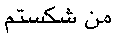 /mæn shekæstæm/.
Now continue!
Mr.KAL'YAAN
June 10, 2012 @ 1:37 pm
Sir,you saw is “shoma didid”? or “shoma did”?
Charanjeet Singh
July 15, 2012 @ 10:52 am
if its plural then its – shoma didid
if its singular then – to didi
Marion.
October 24, 2012 @ 12:01 am
Thanks your web site is great :) i don’t know how to say thank you for now (lesson 11), but thanks a lot, i guess the urdu way “chukriya” won’t be so far.
Raouf
January 20, 2013 @ 9:30 pm
for the verb “to break” it’s “shekestan” or “she kastan” ??
JJJ
May 6, 2013 @ 2:26 pm
@Raouf: after verification, there is a small typo, it is “shekastan”.
http://en.wiktionary.org/wiki/شکستن
Naseer
January 28, 2013 @ 9:14 pm
Brilliant work. I can’t think of any suggestion myself as you have explained everything perfectly.
Thank you ever so much.
Rhys
May 6, 2013 @ 12:08 pm
This is truly amazing. I have learned so much from this website already. It feels good to know that I have learned so much from this website and many others like in, in just a few months. Thanks very much for your efforts!
Azim
June 28, 2015 @ 7:04 pm
what we call “He/she closed”?
and “We closed”?
please help sir
Saad
July 4, 2016 @ 9:41 am
Really it’s useful thanks a lot
Lucie
August 24, 2016 @ 5:01 pm
it should be written *shekastan.
Anyway, great course, merci !
Nadezhda
November 11, 2016 @ 3:32 pm
Thank you so very much for the excellent job you are doing! The passion you use to do this is felt all through your lessons. Easy to learn and understand which is the most important and I haven’t found so far another site as good as yours!
Cheers,
Nadezhda
p.s. Great job on the aduios this really, really helps!